


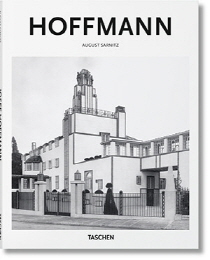


Meet modernist trailblazer Josef Hoffmann, a pivotal character in European aesthetics who pioneered the Viennese Secession and the Wiener Werkstätte. The Austrian mastermind introduced a brave, new minimalism that continues to inspire architecture and design to this day, from monochrome interior schemes to the cutlery on our table.
Before aesthete, designer, and architect Josef Hoffmann (1870–1956) came along, Austrian architecture and design was suffocating under a surfeit of opulent ornamentation and bombastic flourish. With his radical new approach and a band of like-minded figures, Hoffmann was a founding father of the Viennese Secession and Wiener Werkstätte and revolutionized Western aesthetics with a brave new minimalism.
This essential introduction explores Hoffmann’s key ideas, projects, and designs to understand his radical aesthetics and their continued influence on European architecture and design, from monochrome interior schemes to the cutlery we put on the table. We explore his integral role at the center of both the Vienna Secession in 1897 and the Wiener Werkstätte, and his commitment to stylistic purity, including some of Europe’s first major modernist buildings, such as the Purkersdorf Sanatorium (1904) and the Palais Stoclet (1905–1911).
Basic Architecture 시리즈의 특징
이 시리즈는 타셴의 Basic Architecture의 각 권을 특집화한 것으로, 다음을 담고 있다.
해당 건축가의 생애와 작업에 대한 소개
연대순으로 나열된 주요 작품 소개
의뢰인에 대한 정보, 건축학의 전제조건, 건축학적 문제와 그에 따른 해결법
선별된 작품의 목록과 가장 유명한 건물의 위치를 나타내는 지도
약 120가지의 삽화 포함(사진, 스케치, 초안, 설계도 등)
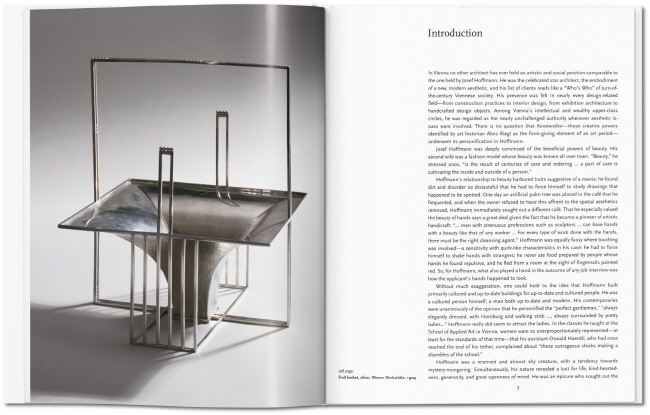
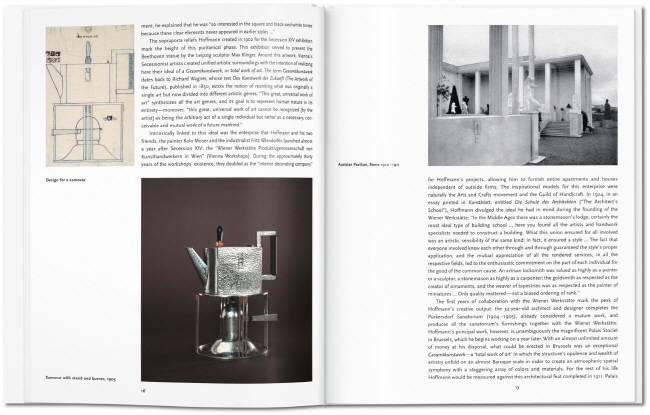
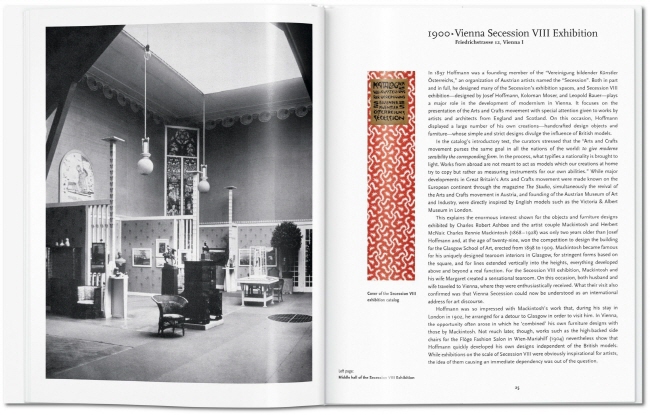
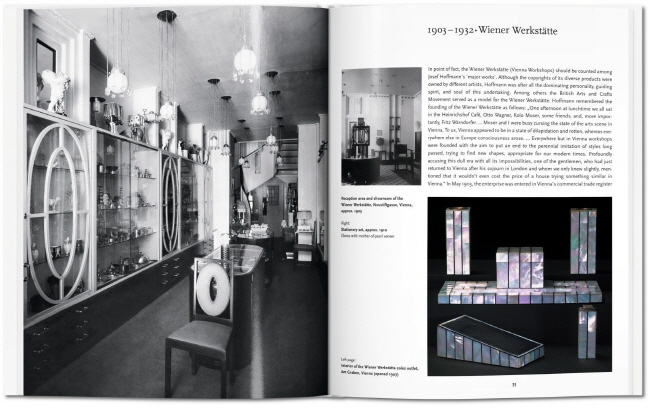
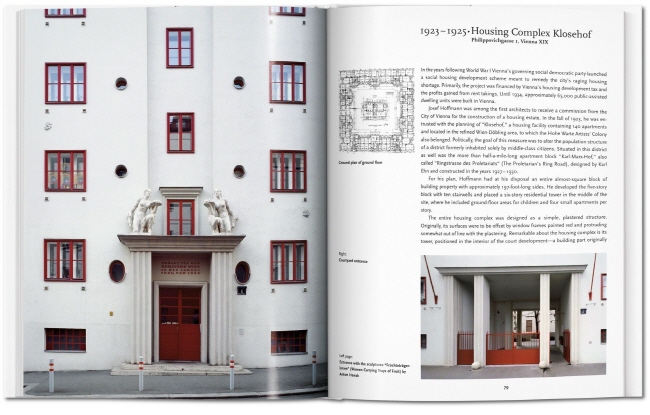
Before aesthete, designer, and architect Josef Hoffmann (1870–1956) came along, Austrian architecture and design was suffocating under a surfeit of opulent ornamentation and bombastic flourish. With his radical new approach and a band of like-minded figures, Hoffmann was a founding father of the Viennese Secession and Wiener Werkstätte and revolutionized Western aesthetics with a brave new minimalism.
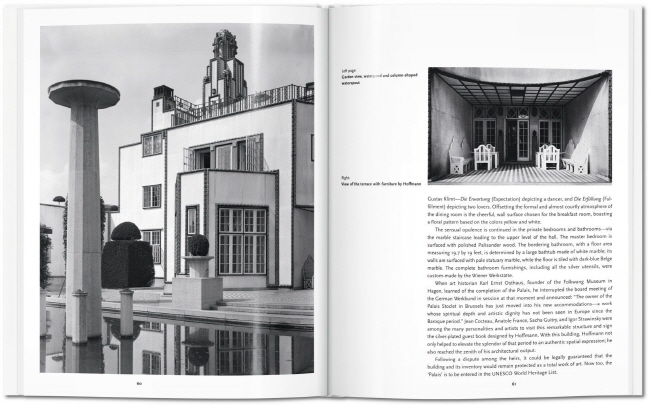
This essential introduction explores Hoffmann’s key ideas, projects, and designs to understand his radical aesthetics and their continued influence on European architecture and design, from monochrome interior schemes to the cutlery we put on the table. We explore his integral role at the center of both the Vienna Secession in 1897 and the Wiener Werkstätte, and his commitment to stylistic purity, including some of Europe’s first major modernist buildings, such as the Purkersdorf Sanatorium (1904) and the Palais Stoclet (1905–1911).
Basic Architecture 시리즈의 특징
이 시리즈는 타셴의 Basic Architecture의 각 권을 특집화한 것으로, 다음을 담고 있다.
The author
August Sarnitz is a practicing architect and professor of history and theory of architecture at the Akademie der bildenden Künste in Vienna. His many publications include books on R. M. Schindler, Lois Welzenbacher, Ernst Lichtblau, Adolf Loos, and E. A. Plischke.
The editor
Peter Gössel runs an agency for museum and exhibition design. He has published TASCHEN monographs on Julius Shulman, R. M. Schindler, John Lautner, and Richard Neutra, as well as several architecture titles in the Basic Art series.


