


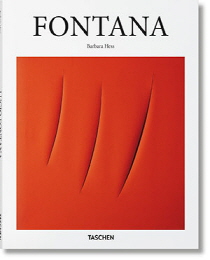


Italian artist Lucio Fontana literally tore the art establishment apart. Trained as a sculptor, he combined form and color in radical spatial gestures, most famously his slashed canvases of the 1950s and ’60s. Regarded as the father of midcentury Spatialism, his provocative practice channeled postwar innovation in a pioneering synthesis of art, technology, and science.
Lucio Fontana (1899–1968) was an Italian sculptor, painter, and ceramicist, regarded as the father of Spatialism, a midcentury modern movement that linked artistic experimentation with scientific principles and theories.
Debuting in Milan, Fontana settled in Paris in the mid-1930s, where he joined the Abstraction-Création group and created expressionist sculptures in ceramic and bronze. He later moved to Argentina, where he developed his highly influential Technical Manifesto of Spatialism, a modernist marvel, characteristic of postwar innovation and fueled by a forward-looking synthesis of art, technology, and science. With Spatialism, the artist sought to project color and form into spaces, most famously in his minimally ripped or slashed canvases, such as his extensive Spatial Concept Waiting series.
This dependable artist introduction follows Fontana on his personal and artistic journey to explore the evolution of his pioneering ideas as well as their remarkable legacy on conceptual and performance art.
Basic Art 시리즈의 특징
문화적·역사적 중요성을 아우르는 작가의 삶과 작품에 관한 상세한 연대기별 요약서
간결한 일대기 소개
설명이 첨부된 100점의 컬러 도판


Lucio Fontana (1899–1968) was an Italian sculptor, painter, and ceramicist, regarded as the father of Spatialism, a midcentury modern movement that linked artistic experimentation with scientific principles and theories.
Debuting in Milan, Fontana settled in Paris in the mid-1930s, where he joined the Abstraction-Création group and created expressionist sculptures in ceramic and bronze. He later moved to Argentina, where he developed his highly influential Technical Manifesto of Spatialism, a modernist marvel, characteristic of postwar innovation and fueled by a forward-looking synthesis of art, technology, and science. With Spatialism, the artist sought to project color and form into spaces, most famously in his minimally ripped or slashed canvases, such as his extensive Spatial Concept Waiting series.
This dependable artist introduction follows Fontana on his personal and artistic journey to explore the evolution of his pioneering ideas as well as their remarkable legacy on conceptual and performance art.
Basic Art 시리즈의 특징
The author:
바바라 헤스(Barbara Hess)(b. 1964)는 미술역사가이며 비평가이자 번역가로 현재 퀠른에 살고 있다. 그의 현대 미술에 대한 많은 글은 카메라 오트스리아(Camera Austria), 플래시 아트(Flash Art), 쿤스트 블리튼(Kunst-Bulletin), 텍스테 추어 쿤스트(Texte zur Kunst) 등에 실리고 있다. 또한 퀠른, 도르트문트, 뒤셀도르프에서 여행 전시인 ‘레디 투 슈트(Ready to Shoot): 와 파리 시립 현대미술관(Musée d’Art Moderne de la Ville de Paris)에서 공동 큐레이터를 맡고 있다. 그의 TASCHEN 저작물로는 빌럼 데 쿠닝에 대한 모노그래프 등이 있다.
바바라 헤스(Barbara Hess)(b. 1964)는 미술역사가이며 비평가이자 번역가로 현재 퀠른에 살고 있다. 그의 현대 미술에 대한 많은 글은 카메라 오트스리아(Camera Austria), 플래시 아트(Flash Art), 쿤스트 블리튼(Kunst-Bulletin), 텍스테 추어 쿤스트(Texte zur Kunst) 등에 실리고 있다. 또한 퀠른, 도르트문트, 뒤셀도르프에서 여행 전시인 ‘레디 투 슈트(Ready to Shoot): 와 파리 시립 현대미술관(Musée d’Art Moderne de la Ville de Paris)에서 공동 큐레이터를 맡고 있다. 그의 TASCHEN 저작물로는 빌럼 데 쿠닝에 대한 모노그래프 등이 있다.


